
Superficial Socialists
Covert conservatism and the curious world of comedy

Socialism is a good thing. It’s an economic and political philosophy where the collective -that is the majority - owns the means of production, ultimately leading to a more equal society. The philosophy embodies an equitable distribution of wealth and essential public services to be provided for free by the state, funded by taxation. If everyone commits to this ideology, then society, and the world, will literally be a better place. In a socialist model the state – i.e. the Government – is designed to serve the public, regulating corporations to make sure they act fairly.
But we are living in an increasingly capitalist society, where the means of production are owned by the very few who continue to get richer by the day, holding consumers (the public) hostage to prices they cannot afford. This is evident in banking with mortgage and lending rates, in the housing market with private landlords and with energy companies making record profits charging increased prices for commodities like gas, electricity and fuel.
If socialism is about equality and fairness then the opposite of socialism is capitalism, otherwise known as conservatism. The greatest exponents of conservatism are, oddly enough, the current Conservative government.
In comedy, you hear a lot of angst and outrage at the concept of conservatism and indeed the Conservatives – delivered in a delightful dose of absurd humour with withering punchlines. Go to any comedy club and you’ll be sure to hear about disgraceful behaviour of landlords, the abandoned hope of ever getting on the property ladder or the difficulty getting a doctor’s appointment. All symptomatic of our current society.
Liz Truss recently said there are a lot of secret Tories out there, and although it’s odd to agree with someone who tanked the economy and tried to blame a “left-wing economic establishment” (an oxy-moron’s moron) I can’t help but relate to this. I’m not referring to covert Conservative voters, those too ashamed to admit their political allegiance. I’m referring to us all, because there’s a secret Tory in in all of us, we just might not get the inclination or the opportunity to activate them. If you manage to accumulate any sort of wealth, privilege or opportunity the proposition of sharing it can be less than palatable for many. “How does helping others benefit you? You’ve got to look after number one, that’s the reality” says a voice inside your head. You start off idealistic then become realistic. Welcome to conservatism.
I was at comedy club on Monday night which prides itself as community, not a business.
“A business creams off the top, a community supports those at the bottom” according to its website. The club runs a lot of free events, for both punters and comedians, with particular emphasis on the “free” part. Except, they’re not really free these events. I went to one of the comic workshops a few months ago, emphatically advertised as “free”. But it wasn’t free because at the end of the session someone stood up to give a passionate speech about the value of community, a club run by comedians for comedians and emphasised the need for donation. A suggested monetary value donation. Conveniently (depending your perception) you’re met with a card reader and bucket on your way out the door.
I’ve got no problem with charging for goods and services, I worked in sales for ten years and I wrote a thesis on the sales process. Sales can get a bad reputation (and rightly so) when it’s executed poorly. There’s an academic definition of selling which defines it as “the creation or transfer of value” which I think is brilliant way to articulate it. I’m always looking for the value proposition in everything that I do, assessing whether something is worth my time and effort. It’s a great way to make decisions. I fundamentally believe that people deserve to be paid – properly - for their time and endeavour and many of the problems we have in society are down to people not being paid enough. But if you want to charge for an event, put an entry price on the door. Quote a suggested donation in advance. Don’t say something is free when it clearly isn’t. To suggest otherwise is completely duplicitous.
On Monday night I got to perform five minutes at one of their new act nights, seen as a stepping stone for meaningful progression at a club which runs live comedy every night of the week in London and has hosted a number of household names. In a room above a pub filled with somewhere between 30-40 people, a handful of new and established comedians performed between 5 and 7 minutes of material. It wasn’t Live at the Apollo and there were no household names, just a mixture of new, fairly new and established comedians running out new and untested jokes. Whilst the event was billed as free, the audience were treated to “the bucket speech” at the end of night, delivered with all the passion and pomp of Tommy Sheridan with a suggested donation of £15.00 each.
Again, let me be clear, there is nothing wrong with charging money. Why would you expect anyone to work for free? I’ve got no issue with holding out for a high price. Something is only worth what someone is willing to pay. I didn’t agree with the suggested donation FYI, it just didn’t represent an equitable value proposition - the price was too high for a new material on a Monday night.
The issue I have is, to my knowledge, no comedian was being paid for their time. How does that support anyone at the bottom? These “communities” also rely on volunteers, normally comedians themselves. They might help with managing the booking system, sifting through hundreds of applications from comics so desperate get stage time they’re only too happy to perform for free. They might stand with the bucket, take payments or check tickets. They might not get paid, but they are rewarded. Often in stage time (why should anyone do anything for free, right?)
So now we’re at the point where performing for free isn’t enough. I get it. It’s the type of thing I might have done ten years ago and it’s a natural inclination; do whatever helps you succeed. But in doing so, you’re simultaneously driving the price of your labour into the ground, punishing the stakeholders (you) and rewarding the shareholders (them). This also contributes to an ever-increasing problem in the Arts; who can afford to work for free in order to progress? The wealthy, the privileged and the middle-classes. These social groups absolutely have every right to be part of the Arts and Culture scene, diversity demands their inclusion, but the people who will most likely miss out will be the working classes and those from marginalised backgrounds.
This isn’t the problem of one club or “community” (incidentally, one community has £259,000 cash at bank and in hand, which equates to shareholder funds of £177,000 according to their last set of accounts) but the industry as a whole and we as comedians are also culpable for our participation and perpetuation - myself included.
How do we take steps to address it? We can refuse to perform at these clubs but the danger is you don’t get to perform at all. And if you don’t perform at these clubs you’ll never get any meaningful progression. (Progression is eventually working your way onto a weekend bill where you perform for free until eventually you start to get paid).
Fear holds you captive. I was and am worried about writing this blog, wondering if talking about these clubs is an act of rebellion or self-sabotage. Speaking out can render you a rabble-rouser, a disruptive force that’s best ignored. Most people don’t speak out because once they start getting stage time or spots at a comedy club they think “well, I better keep my mouth shout so I can keep getting booked”. I’m aware I might be too naïve, too idealistic. I’ve had a long and varied career where I’ve paid the price for not playing the game or winding my neck in.
But comedy is the one place you shouldn’t have to. So I’m speaking out and saying that the current model is a lot of shit. I’m also saying that I’m part of the problem by rewarding this model by playing in clubs which charge people to see comedians but don’t pay them. And I’ve also put on a comedy night - two to be precise - where I only paid a couple of the comedians (the MC, Headliner and the Opener) and I’m in the wrong for that.
As I get older I’ve become more aware of myself and what I (think) I stand for. So I’m going to try as best I can to not contribute to this covert conservatism under the guise of a superficial socialist.
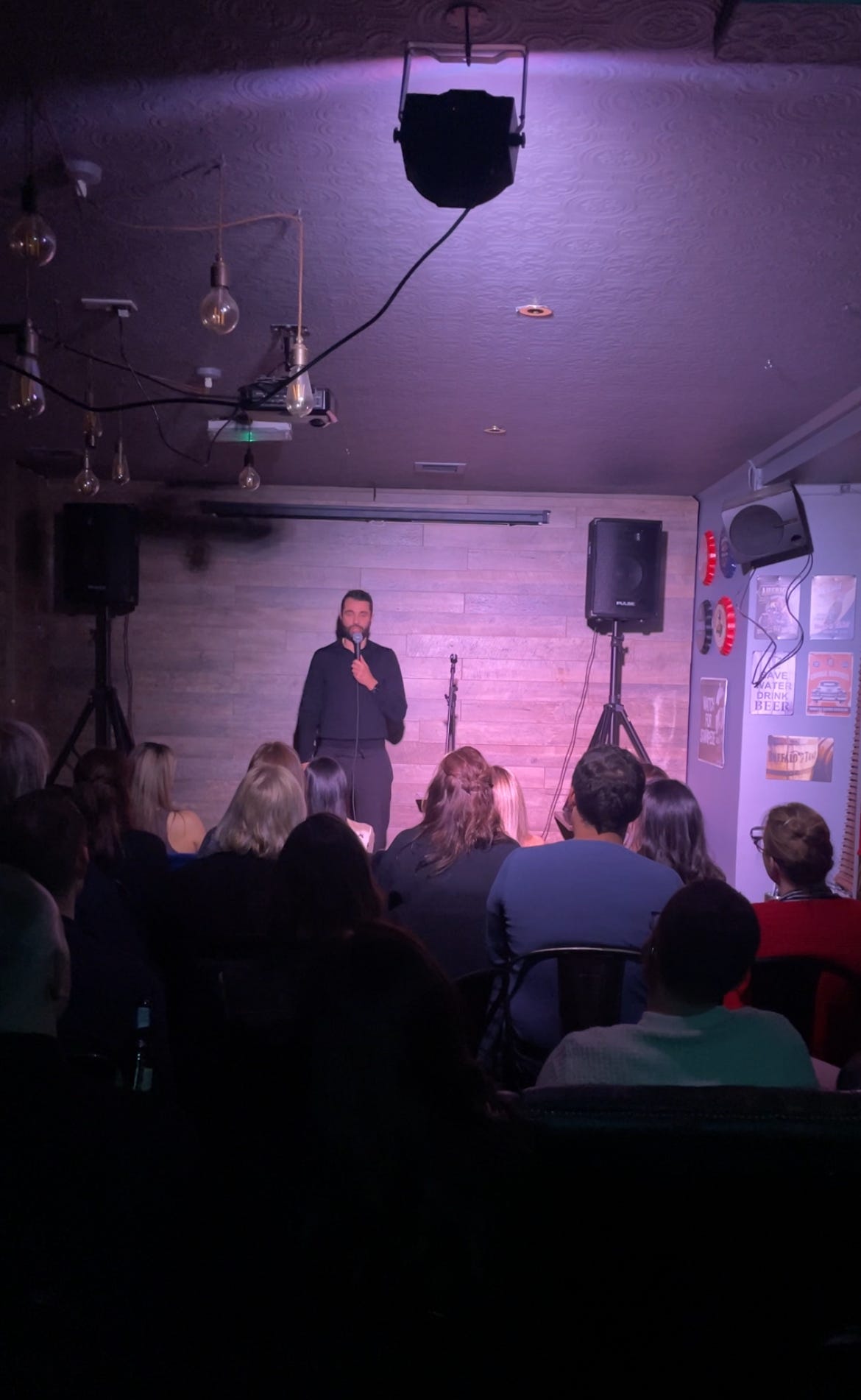
I’m very grateful to everyone who bought a ticket and came to see my latest work-in-progress show. It offers me a brilliant opportunity to run out new material and make some money - I like to think I was good value.
Lots to agree on here! In many ways I think TikTok/the internet has made it easier to be a disruptor. If your income or career isn't reliant on clubs then I think it's good to speak up for those who are dependent but scared to say anything.
I think we are probably also getting old and less tolerant of bullshit... haha
Hospitality staff have unionised, why not comedians?